Frank Sheeran and Charles Brandt: Interviews and Recording of Sheeran’s Key Confession
I Heard You Paint HousesFrank Sheeran and Charles Brandt’s relationship was the working alliance through which Sheeran’s account of Jimmy Hoffa’s disappearance became the foundation of I Heard You Paint Houses. It was neither a single confession nor an unmediated record: it took shape through an abandoned first interview, years of questioning and recordings, periodic reversals, and a final public affirmation as Sheeran was dying. Brandt’s role as interviewer, former prosecutor, and eventual confidant helped elicit the story, while the changing conditions of their conversations remain central to how that story reaches the reader.
The Aborted Interview and Return
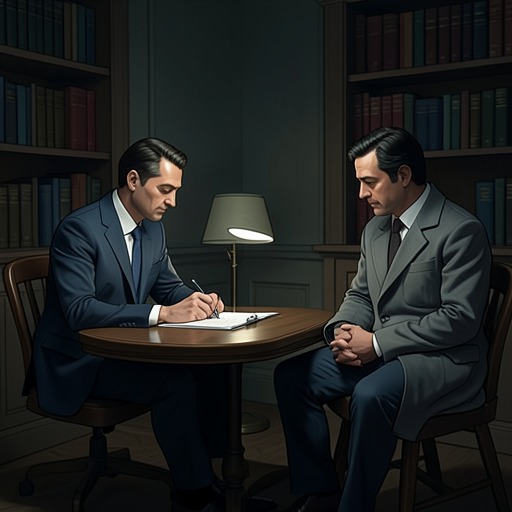
Brandt first interviewed Sheeran in 1991, shortly after Brandt and a partner had helped secure Sheeran’s early release from jail on medical grounds. The encounter quickly became more interrogative than Sheeran was prepared to tolerate. He ended it, having admitted more than he was comfortable with, and Brandt left the door open for him to resume if he became willing to answer questions again. Their collaboration began, then, with both disclosure and withdrawal: Sheeran had spoken, but wanted control over what that speech might mean.
The opening came years later, after Sheeran’s daughters arranged a private meeting for their aging, physically disabled father with Monsignor Heldufor at St. Dorothy’s Church in Philadelphia. The monsignor granted Sheeran absolution so he could be buried in a Catholic cemetery. Sheeran then contacted Brandt, asked him to attend a meeting at his lawyer’s office, and agreed to be questioned. The interviews resumed and continued for four years. The sequence connects Sheeran’s wish to confess with a religious encounter, but the evidence does not make Brandt’s interviews simply an extension of that absolution: they were a separate, sustained process of questioning.
An Interviewer Who Kept Him Talking
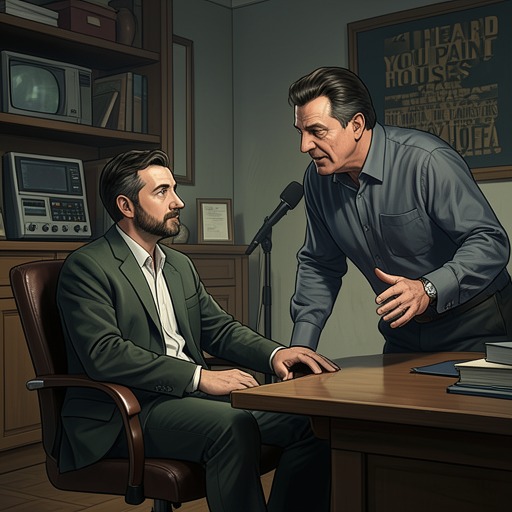
Brandt brought to the interviews his experience as a homicide and death-penalty prosecutor, a lecturer on cross-examination, and a student of interrogation. He also had written about the Supreme Court’s exclusionary rule concerning confessions. The book presents this background as practical to the relationship: Brandt kept asking, pressing Sheeran to continue, and working through a storehouse of material rather than treating one admission as sufficient. Sheeran once told him that he was worse than any police officer he had dealt with.
The work extended beyond formal sessions. Brandt spent time with Sheeran, met people described as alleged mob figures, traveled with him to Detroit to search for the site of Hoffa’s disappearance, and met Sheeran’s lawyer, relatives, and friends. During the project, Sheeran called Brandt repeatedly throughout the day, practically every day, to discuss a wide range of subjects. Brandt observed that Sheeran called many of the people he discussed good people and usually ended conversations by saying everything was copacetic. When Sheeran began to regret an admission, the calls grew more numerous and nervous; at times he tried to take his words back, but later settled into having told someone. Their closeness thus gave Brandt access to recurring changes in Sheeran’s confidence, not just to the statements preserved in interviews.
The process also had a legal dimension. For much of the questioning, Brandt sought to protect Sheeran’s rights so that his statements would not amount to a confession admissible in court. That caution matters alongside the book’s account of an earlier controversy: in 1978, the Federal Bureau of Investigation believed Sheeran had confessed by telephone to Steven Brill, author of The Teamsters, and sought a tape. Dan Moldea later wrote that Brill had told him he possessed a recorded confession, while Brill publicly denied it. Brandt’s project therefore did not begin in a vacuum; it developed amid claims about an earlier, disputed confession and the legal consequences of preserving one.
From Private Admission to Public Account
About two years into the interviews, Sheeran had told Brandt that he was the shooter in the Hoffa case. Roughly a year before their trip to Detroit, Brandt arranged a meeting at lawyer Emmett Fitzpatrick’s office with Fox News correspondent Eric Shawn and producer Kendall Hagan. The intention was to make Sheeran comfortable with one correspondent he could trust and to have him say for the first time to anyone besides Brandt that he had shot Jimmy Hoffa. This plan shows Brandt acting not only as questioner but as intermediary, managing the step between a private account and a public one.
Two nights before the meeting, Sheeran gave Brandt a typewritten letter supposedly signed by Hoffa in 1974, after Frank Sheeran Appreciation Night. More than half of it contained material Sheeran had already told Brandt, while the rest could support a version of events Sheeran had promoted with his friend John Zeitts. Brandt said he would investigate its authenticity. At the meeting, Shawn asked whether Sheeran could find the house; Sheeran gave directions and mentioned a footbridge, details he had never before disclosed to Brandt. He then publicly stated to someone other than Brandt that he had shot Hoffa twice in the back of the head. Fox News conducted preliminary independent research and confirmed the historical value of Sheeran’s account of Hoffa’s last ride, though that preliminary work was not a forensic verification of the killing.
The Forgery and the Limits of Trust
The letter led to a serious rupture in the project. Brandt contacted forensic scientist Henry Lee’s laboratory about testing Hoffa’s signature and latent prints, but initially lacked exemplars and did not want to alert the Federal Bureau of Investigation before the book had a publisher. After a publisher became involved, the letter was examined under special light. Its paper had been manufactured in 1994, not 1974, and its signature had been inked over a faint photocopy of an authentic Hoffa signature. The letter was a forgery. Although it was not central to the book and could have been removed, the publisher canceled the book deal. Brandt was angry with Sheeran; an editor suggested that Brandt had escaped worse, given what Sheeran had done to other friends. The episode makes the relationship’s basic problem concrete: repeated access and apparent intimacy did not guarantee that every document Sheeran supplied was genuine.
Even so, Sheeran had read and approved each chapter and then reread and approved the whole manuscript. That approval sits uneasily beside the forged letter, but it is part of the same record of collaboration: Sheeran participated in shaping the written account, while Brandt remained responsible for checking material that could not be accepted on trust alone.
Final Confirmation and Ending
After the book deal was lost, Sheeran’s health worsened. During his final illness, after speaking with Fitzpatrick, he decided to go on videotape and stand behind the book’s account, including what happened to Hoffa on July 30, 1975. Brandt asked whether he would support what was written, and Sheeran agreed. Before the recording, Sheeran had received confession and communion from a visiting priest; he told Brandt he was at peace. When the camera was switched on he briefly became hesitant, then said he would do it and asked for a mirror to check his appearance.
Brandt gave Sheeran a galley copy to hold before the camera and questioned him without the protective language used during their ordinary interviews. Sheeran confirmed that the book’s statements about Hoffa came from what he had told Brandt and said that he stood behind what was written. When Brandt tried to draw him into further detail about Hoffa, Sheeran resisted and told him to let the book speak for itself. The camera battery died, and Brandt also stopped the video at intervals, recording some material on audio tape; ample material was nevertheless preserved. The format changed, but the guardedness did not disappear: Sheeran confirmed the account while limiting how far he would elaborate.
Sheeran died six weeks after that final interview. Brandt and his wife visited him at least weekly, and Brandt sometimes went alone; Sheeran was bedridden, barely looked up, and allowed Brandt to feed him a little Italian water ice and sip water through a straw held by Brandt’s wife. Brandt last saw him on December 6, 2003, and heard Sheeran’s mumbled assurance that he was not going anywhere. The collaboration ended not with a complete account of every uncertainty, but with the recorded endorsement, the surviving gaps, and the loss of any opportunity to press further. In that sense, Brandt’s relationship to Sheeran was both the means by which the confession was preserved and the boundary beyond which the testimony could no longer be tested by its source.